A better working record for flying days
GlideHQ is being built to join aircraft status, inspections, the flying order, qualified duty cover, launch logs and member accounts. It is not a launched service. Canadian clubs can register interest for early access and help shape the priorities. The build targets the paper records and monthly spreadsheets that make volunteers repeat the same work.
- Register interest free
- Founding clubs shape the first version
- No commitment

What is gliding club management software?
Gliding club management software is the shared operating record for a club flying day. It starts with aircraft serviceability and inspections, then manages the moving flight list, instructor and launch duties, currency, movements and charges. For a Soaring Association of Canada club, the software must understand that flying depends on qualified people and available aircraft rather than fixed calendar slots. GlideHQ is in development for that purpose, with separate support for winch launches and aerotows. It has not yet launched.
Today's airfield activity in one view
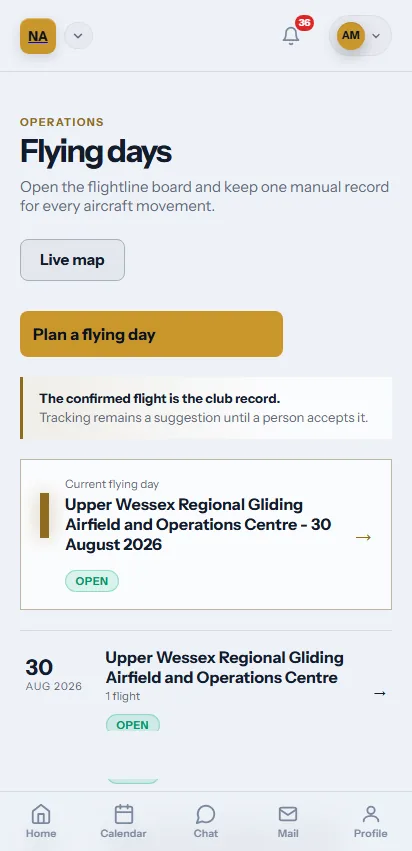
The phone screen is taken from GlideHQ in build, running a demo club. It displays the present flying day as open, links to a live map and keeps one club record for every aircraft movement. This is not evidence of a live product. It shows the intended mobile view of activity that paper logs cannot share.
- The current day status tells members that flying is open at the airfield right now.
- A one-tap live map keeps the operational picture close to the flying-day record.
- One record per movement provides the base for aircraft history and accurate member charges.
GlideHQ on a phone, from the build running a demo club. Nothing to install.
What gliding asks for that generic club software does not do
Any club platform will hold your members and take your subs. These are the parts clubs end up running in a spreadsheet alongside it.
Sign off each aircraft before use
A daily inspection must be recorded ahead of the first flight. The serviceability status should decide whether the aircraft appears available. A normal asset calendar does not provide that essential control.
Let the flying queue respond
Pilots move through an order that changes when weather, check flights or launch problems intervene. The list must be visible to everyone at the launch point. Fixed bookings soon become inaccurate.
Find roster gaps before flying day
The operation needs instructors, winch drivers, tug pilots and duty pilots. If a key person is missing, the airfield may not open. Early visibility gives officers time to arrange suitable cover.
Put currency before solo launch
Annual checks, time since flying and conversion to type can require a check flight. That requirement should be visible while the day is organised. Discovering it beside the glider disrupts the queue.
Turn movement logs into clear accounts
Winch launches, aerotows and soaring time may use different rates. The system records each against the member and aircraft. Treasurers then work from the flight record instead of rebuilding charges from paper.
Keep two launch systems accurate
Winch and aerotow require different crews, procedures and charges. One club may offer both on the same day. GlideHQ will retain the right detail for each without splitting the wider member record.
What GlideHQ will handle
Launch list
Keep the daily flying order current without relying on a whiteboard.
Fleet records
List club gliders, towplanes and maintenance status in one place.
Duty roster
Schedule instructors, winch drivers and duty pilots evenly on the roster.
Movement logging
Record every launch and flight hour against members and aircraft.
Member access
Provide one login for bookings, accounts and club news.
Training oversight
Put progression and sign-offs where instructors can check them.
Plan ahead while GlideHQ is in build
GlideHQ is not ready for clubs to use. There is no live import service to offer. Keep using your current records while we build it.
What you may use now
- The airfield whiteboard
- Handwritten lists and logs
- A rebuilt monthly accounts sheet
- Duty-cover phone calls
List who keeps each record and where the latest copy lives.
-
Tell us which club job needs help
Describe the work you want to change, such as the duty list or member accounts. We can use that to discuss what the first version needs.
-
Use made-up examples
Share field names or a blank form if you want to explain a record. Do not send member details, payment data or private club files with an interest enquiry.
Tell us what you run now to help shape GlideHQ. Registering interest does not start an import.
Who is behind GlideHQ
There is no published gliding case study yet, and we are not going to invent one. What we can point at is the engine underneath. RowHQ runs Oundle Town Rowing Club day to day, with real members, real money and real race entries going through it.
GlideHQ is a different sport on the same foundation, built by the same people. It is in build, and founding clubs get a direct line to the people writing it.
Questions about gliding club management software
What is gliding club management software in Canada?
It is one system for aircraft condition, daily inspections, the flying list, duty cover, launch records, training and member accounts. A Soaring Association of Canada club can replace the launch whiteboard, paper movement log and billing spreadsheet. GlideHQ is being built for gliding-specific operations rather than fixed bookings. It is not launched.
How much will GlideHQ cost a Canadian club?
GlideHQ is still in build. Published pricing is free below 21 active members. The 21 to 30 band is C$27 a month excluding GST or HST. The 251 to 300 band costs C$220 monthly. Every band includes all features. No transaction fee is taken, and Stripe pays card funds into the club's own account.
Can vulnerable sector check records be stored?
The planned member records can include relevant screening information. The club must request a vulnerable sector check through local police rather than asking the volunteer to obtain one. British Columbia uses its Criminal Records Review Program. Federal law sets no renewal frequency. GlideHQ will hold the club's record, while the committee decides and follows its screening policy.
Will the system stop an unserviceable glider appearing available?
Yes. Aircraft condition and the signed daily inspection are core requirements in the build. The serviceability record will sit ahead of availability, so a glider with a fault does not remain in the flying choices. That is different from a generic calendar that treats every aircraft as an ordinary bookable asset.
How will the moving flight order work?
Members join an ordered list rather than reserve fixed half-hour appointments. Officers can move the order as weather, check flights and launch issues change the day. Everyone at the launch point sees the current version. The build is designed around that queue because it matches actual club operation.
Could a grant pay for gliding club software in Canada?
It can. Canadian clubs put schemes like Canadian Tire Jumpstart and the Community Sport for All Initiative toward participation and running costs, and software sits comfortably in that kind of application. Under 21 active members the platform is free regardless, and the annual price is charged at ten months.
Register interest
Be first in line when GlideHQ launches, and help shape what gets built first.
The rest of the HQ family
One app per sport, sharing an engine underneath. Plenty of clubs run more than one.